
Faster layout linting in SQLFluff 4.5
SQLFluff 4.5 removes repeated work from layout checks, helping you spend less time waiting on linting for complex queries and larger projects.
SQLFluff 4.5.0 makes layout linting faster by cutting repeated work. If your queries have wide SELECT lists, many CTEs or plenty of layout violations, there’s less work between you and your lint results.
What changed?
Several layout rules previously searched the same parts of a query repeatedly. Those searches became increasingly expensive as queries grew. The release replaces them with direct lookups and cached positions, and lets layout rules reuse work on an unchanged file instead of rebuilding it for each rule.
Alongside these changes, 4.5 reduces per-file setup costs and sends less data between worker processes. You can benefit with the Python parser; switching to the optional Rust engine isn’t required.
How much time does it save?
In our comparison of 4.4.0 and 4.5.0, median total lint time fell by 21–35% with one process across three public fixture samples. With four workers, the reductions ranged from 6–20%. These are whole-command timings, covering all release changes, rather than an isolated measurement of layout rules.
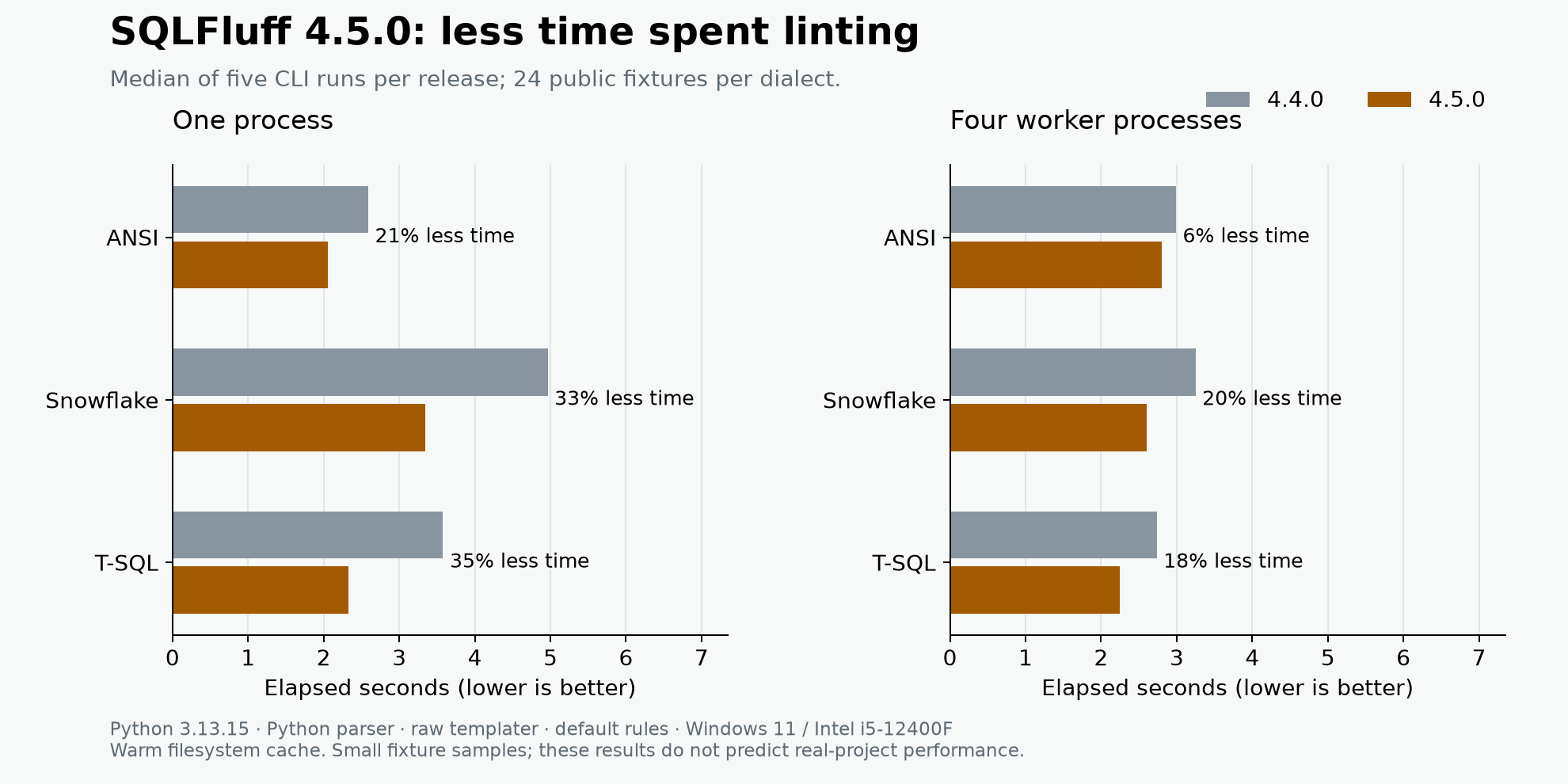
We used 72 files—24 each for ANSI, Snowflake and T-SQL—with the Python parser, raw templater and default rules. Each result is the median of five measured runs per release and scenario, after one warm-up: 60 measured runs in total. Both releases used Python 3.13.15 and identical dependencies on the same Windows 11 desktop.
These small samples illustrate the improvement, rather than predict your project’s runtime. Background activity introduced variability; the small ANSI four-worker difference needs a quieter rerun before drawing a firm conclusion. We haven’t measured a real project or dbt/Jinja rendering in this comparison.
Download the timings and ranges, the SVG chart, or the full methodology, inputs and reproduction bundle.

When will you notice it most?
We expect the biggest benefits where layout checks account for a large share of the work: wide SELECT lists, many CTEs, long sequences of statements and numerous layout violations. Smaller per-file savings can also accumulate when checking many files repeatedly in development or CI. These are expectations based on the implementation, not additional measurements from our experiment.
The difference may be less visible when linting just a few tiny files, when the relevant layout rules are disabled, or when project loading and rendering dominate the wait. More workers aren’t always better for small batches: four workers took longer than one process on our ANSI sample in both releases.
There is complementary evidence from larger workloads. The
reflow reuse PR reported an
18% reduction in parallel fix time on 565 T-SQL files, and the
worker communication PR
reported 22% on 567 files. Those used Python 3.14, the Rust parser and eight
workers, and measured separate changes against different baselines. Their
percentages shouldn’t be added together or to our results.
Try it on your project
Upgrade using your normal dependency manager. For a standalone pip installation:
python -m pip install --upgrade sqlfluff
sqlfluff lint path/to/your/sql
For pre-commit, update the hook revision to 4.5.0. Check templater-plugin
compatibility before upgrading, and compare repeated runs with the same SQL,
configuration, Python version, parser and process count.
See the release notes for the full set of changes. Thank you to Josh Markovic, keraion, and everyone who helped implement, test and review the performance work.